The Free Intelligence Trap.
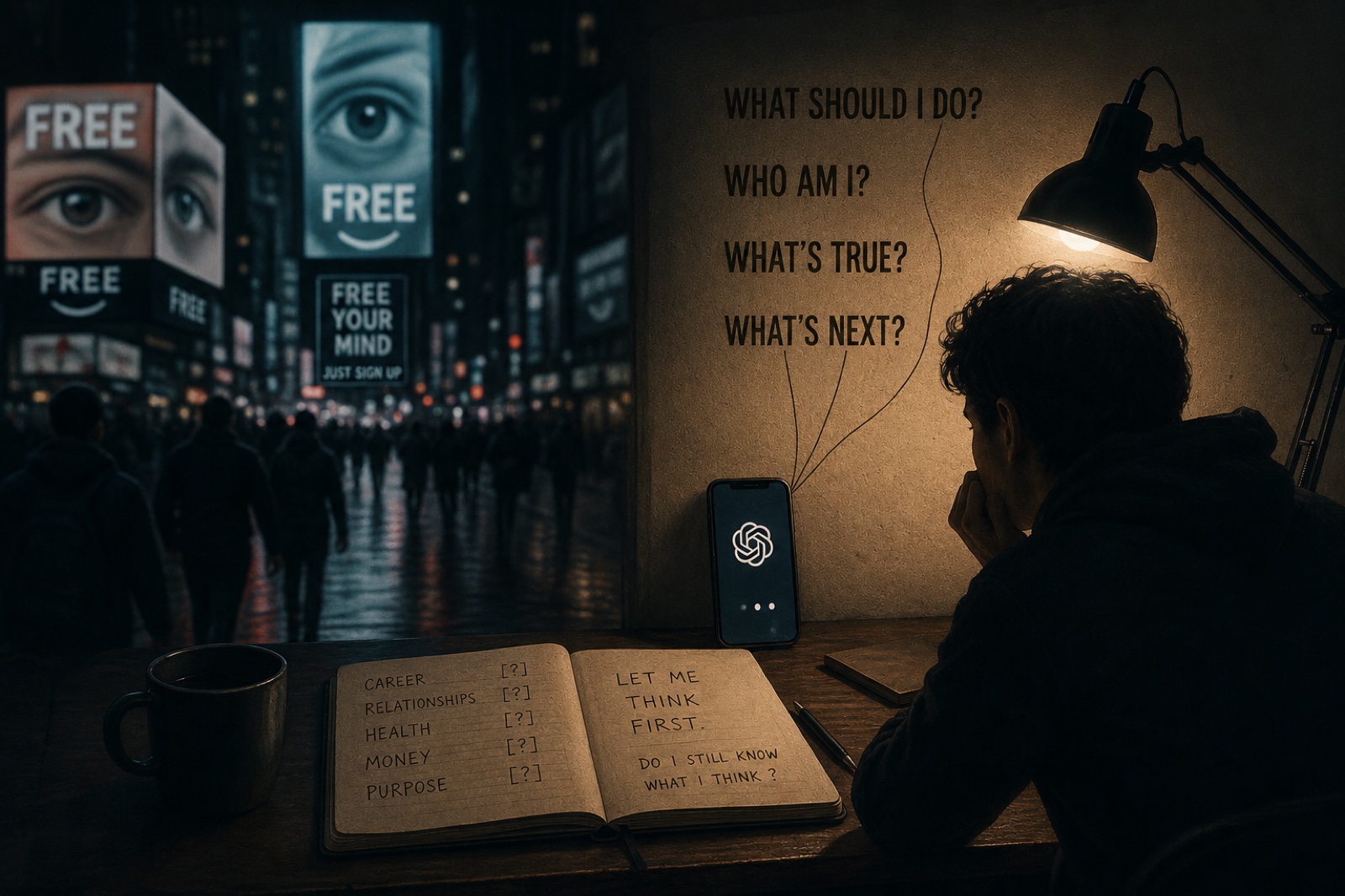
Free is the most dangerous price because it feels like the absence of a price.
It is not. Free removes the moment of resistance. No card details, no invoice, no decision that feels financial enough to slow you down. You enter first, form the habit first, trust first. The business model arrives later, already inside your routines. That is why free works so well. It does not ask “will you pay?” It asks something softer: why not try?
Behavioural economists have studied this distortion. In the “zero price effect,” people do not treat zero as merely a very low price. They treat it as psychologically different. Shampanier, Mazar and Ariely’s classic paper showed that zero pricing made the cheaper option dramatically more attractive than standard cost-benefit reasoning would predict.1 Free does not only reduce cost. It changes perception.
The internet was built on that distortion. Free search, free email, free maps, free messaging, free video, free social media, free AI. The surface story is generosity. The deeper story is that free is one of the most powerful customer-acquisition technologies ever invented.
The old warning, “if you are not paying for the product, you are the product,” was useful for the social internet. It is not enough for the AI internet. In the old free internet, the platform wanted your attention. In the new free AI layer, the platform may want something more intimate: your uncertainty. Not just what you watch, click, follow or search. What you are trying to decide.
Free AI is not just the next ad-supported product. Search monetized what people wanted. Social monetized who they were. AI may monetize the moment before they decide.
I. The old argument is true, but incomplete
This is not a new conversation.
Tim Wu wrote about the attention merchants: the industries that capture human attention and resell it to advertisers, a story that runs from nineteenth-century newsprint through television and into the feed.2 Shoshana Zuboff gave the system a harsher name, surveillance capitalism. Her argument was not merely that platforms collect data. It was that human experience gets converted into behavioural data, then used to predict and influence future behaviour.3 Jaron Lanier attacked the moral structure of the free internet directly, arguing that free online services often feed schemes that make money by subconsciously manipulating people.4 Cory Doctorow later gave us the most memorable word for platform decay: enshittification. First platforms are good to users, then they are good to business customers, then they extract from both to maximise value for themselves.5
All of that is right. But AI changes the layer being monetized. The attention economy was about capturing time. The surveillance economy was about predicting behaviour. The enshittification story was about platform power after lock-in. The AI economy may go one level deeper. It does not only sit between you and content. It sits between you and your own next thought.
A search engine answers what you ask. A social feed shapes what you see. An AI assistant helps form what you think.
II. The old internet sold access to attention
The old bargain was simple. Users received free services. Advertisers paid to reach them. The scale became enormous.
Meta reported $200.97 billion in revenue for 2025, with 3.58 billion daily active people across its family of apps in December 2025; ad impressions rose 12% across the full year while average price per ad increased 9%.6 Alphabet shows the same machine from the search-and-video side: in Q4 2025, Google Services revenue rose to $95.9 billion, and YouTube revenue across ads and subscriptions exceeded $60 billion for the full year.7
Those numbers are evidence of a structure. Free scales the user base. Scale creates attention. Attention creates data. Data improves targeting. Targeting improves ad performance. Ad performance funds the free service. The free service grows again. The UK Competition and Markets Authority described attention and data as critical inputs in digital advertising, and found that Google and Facebook’s access to consumer attention and data reinforced their market power, because greater scale generated more data, better ad products, more revenue, and more investment capacity.8
That is the old internet bargain. It was not fake. Users got real value, the services were useful, and that is why it worked. But it was never free in the deeper sense. The user did not pay at the door. The user paid by becoming measurable.
III. The product was always the prediction
The phrase “you are the product” is emotionally satisfying but technically imprecise. You are not exactly the product. The product is access to your probable future behaviour.
Advertisers do not only want to know your age, location or interests. They want to reach you at the moment when a message can alter an action. Platforms do not only want to know who you are. They want to know what you might do next. The FTC’s 2024 report on major social media and video streaming companies described “vast surveillance” of consumers, including large-scale data collection and monetization practices, and recommended limits on data retention, sharing and targeted advertising, with stronger protections for children and teens.9
Data does not need to be sold directly to be monetized. A company can truthfully say “we do not sell your data” while still making money from what your data makes possible. The valuable thing is not the raw record. It is the ability to model, rank, recommend, target, nudge and predict. The platform becomes a behavioural instrument wrapped in a product.
IV. AI changes the location of the instrument
Social media instruments your attention. AI instruments your intent. That is the key difference.
A social app watches what you engage with after the feed presents options. An AI assistant often receives the question before the user knows what the right options are: what should I study, should I quit my job, how do I fix this relationship, which business should I start, what should I buy, how should I respond, can you help me think through this. The user is not merely consuming. The user is unresolved.
AI enters at the moment of uncertainty, and uncertainty is closer to decision than attention is.
That is why free AI deserves a different analysis from free social media. OpenAI’s ads documentation is careful. It says ads in ChatGPT do not influence answers, conversations are not shared with advertisers, and user data is not sold to advertisers. Its current ad test applies to logged-in adult users on Free and Go tiers, while Plus, Pro, Business, Enterprise and Education tiers remain ad-free.10 That distinction matters. The serious critique is not “ChatGPT sells your chats to advertisers.” OpenAI says it does not.
The serious critique is broader. What happens when the free business model moves into the interface where people think, decide, write, learn, code, shop and plan? Even if ads are clearly labelled, even if conversations are private from advertisers, even if the company behaves responsibly, the category itself is more intimate.
V. The hidden price is dependency
Data privacy matters. But if we stop there, we miss the deeper price. The deeper price of free AI may be cognitive dependency.
A person who uses AI well becomes more capable. They think with a powerful external instrument. They learn faster, write better, code earlier, explore options, challenge assumptions, and access expertise that used to be expensive. That is the optimistic side, and it is real.
But dependence forms quietly. You stop searching widely because the assistant summarises. You stop drafting badly because the assistant drafts cleanly. You stop sitting with confusion because the assistant resolves it. You stop comparing sources because the answer arrives synthesised. You stop developing taste because the model offers polished defaults. You stop asking “what do I think?” and start asking “what does the system suggest?”
The danger is not that AI makes people stupid. The danger is subtler: it may make people less practised at the struggle that produces independent judgment. A tutor should strengthen the student. A tool should extend the user. An assistant can become a crutch if it occupies the moment where the user would have formed the mental muscle themselves.
That is a much larger transaction.
VI. The strongest case for free AI, and for free ads
The honest version of this essay has to say something uncomfortable. Free AI may be one of the most important democratising technologies ever built.
A paid-only AI world would be brutal. It would mean the richest students get tutors, the richest workers get productivity tools, the richest founders get strategy partners, the richest companies get coding agents, and everyone else gets left behind. Free AI changes that. It gives ordinary people access to translation, writing help, coding help, legal-adjacent explanation, research support, business brainstorming, interview preparation, financial explanation, tutoring, health information and technical guidance. The old internet gave people access to information. AI gives people access to assistance. That is a real leap.
So the answer cannot be “free is evil.” Sometimes free is access. Sometimes free is inclusion. Sometimes free is the only reason a person gets to participate in a system that would otherwise be priced above them. A world where every capable AI assistant costs $200 a month would not be morally cleaner. It would be more unequal.
If intelligence becomes expensive, inequality compounds at the speed of thought.
There is also a stronger defence of ads than critics usually admit. Targeted ads can fund products people value, help small businesses reach customers without television budgets, and surface things people actually want. Google says Search ads are shown only when they are relevant to search terms, and Google Ads allows advertisers to reach people actively searching for products and services.11 A good ad at the right moment can be information. A free service funded by relevant advertising can be better for users than no service at all. The paternalistic critique of ads sometimes goes too far. People often knowingly trade attention for access, and many would rather see ads than pay subscription fees.
So the problem is not advertising itself. The problem is invisible optimisation. The question is not whether a company earns money. It is whether the system’s incentive is aligned with the user’s welfare. Is the product becoming better at helping me, or better at predicting me, or better at keeping me dependent, or better at converting my uncertainty into someone else’s revenue?
Free is not the enemy. Hidden optimisation is.
VII. The privacy premium
One way to see the real price of free is to look at what companies charge to remove the extraction layer.
Meta’s subscription model makes the bargain visible. In the UK, Meta announced that users could subscribe to stop seeing ads on Facebook and Instagram, while those who continue using the services for free would keep seeing ads, and that subscribers’ personal data would not be used to show them ads.12 In Europe, Meta similarly framed the choice as paid access without ads or free access with ads, including a less personalised ad option after regulatory pressure.13 OpenAI’s ad model has a similar visible split: Free and Go tiers are included in ad testing, while Plus, Pro, Business, Enterprise and Education tiers are not.10
This is the privacy premium. The user with money can buy a cleaner experience. The user without money gets the subsidised version. That does not automatically make the free version abusive, but it does create a two-tier digital world. One layer is quieter, more private, less interrupted, less targeted, more controlled. The other is free. The people most exposed to manipulation are often the ones least able to buy their way out of it.
If privacy becomes a paid feature, it becomes less like a right and more like a luxury subscription. In the AI era, that split sharpens. The paid user may get stronger models, longer memory, fewer interruptions, better privacy defaults, more integrations, and fewer commercial incentives near the moment of decision. The free user may get access, but with limits, ads, nudges, data controls they may not understand, and subtle dependence on a system whose business model they do not fully see.
VIII. The intent economy
The old internet monetised attention because attention was where the user was. The AI internet may monetise intent because intent is where the value is.
Search intent is explicit: “best running shoes.” Social intent is inferred: “this person likes fitness content.” AI intent is conversational: “I am training for a marathon, my knees hurt, I have $150, what should I buy?” That third version is richer. It contains context, constraints, uncertainty, goals and timing. It is closer to purchase, closer to belief, closer to action, closer to behaviour change.
This is why AI advertising and AI commerce will be so sensitive. The assistant is not merely displaying options beside a query. It may be helping the user form the query. The product is no longer only the feed. The product is the moment before choice. If that moment becomes commercially intermediated, the stakes are higher than banner ads, search links or sponsored posts. The danger is not that every recommendation becomes corrupt. The danger is that users may not know when the system is helping them think and when the system is helping a market reach them.
A paid product asks for money before trust. A free product asks for trust before money. That is why free is so powerful. By the time payment appears, the user may already have built the habit. By the time privacy questions arise, the user may already have stored the memories. By the time ads appear, the assistant may already be part of the workflow.
This is the old platform pattern with a more intimate object. Doctorow’s enshittification describes how platforms often begin by creating value for users, then shift toward business customers, then finally extract more aggressively once everyone is locked in.5 The AI version may not look like a feed getting worse. It may look like the assistant becoming more commercial, more integrated, more default, more necessary and harder to leave. Your notes are there. Your workflows. Your memories. Your writing style. Your coding patterns. Your preferences. Your decision history. At first the assistant is a tool. Then it becomes infrastructure. Then leaving it feels like losing part of your extended mind.
That is the free intelligence trap.
The answer is not to reject every free product. Free tools can be extraordinary. Free AI can help people learn, build, escape bad circumstances, start companies, understand complex systems, communicate across languages, and compete with people who had better education or more money. The answer is not abstinence. It is literacy, of a particular kind. Not a checklist. A deeper one. The question that matters most is whether you still know what you think before the machine answers. In the AI era, the deepest form of independence may not be refusing help. It may be preserving the ability to think before help arrives.
The old free internet wanted your attention because attention was the scarce thing it could sell. The social internet wanted your behavioural data because prediction made advertising more valuable. The AI internet may want your intent because intent sits closest to action. Search knew what you were looking for. Social knew who you were. AI may know what you are about to decide.
The danger is not that free AI exists. It should exist. A world where intelligence is locked behind high subscription fees would be worse. The danger is that the cheapest intelligence may become the most expensive dependency. A free social app competes for your time. A free AI assistant participates in your thinking. And once a product becomes part of how you think, the real price is no longer measured only in money, data or ads.
1 Shampanier, Mazar & Ariely (2007). Zero as a Special Price: The True Value of Free Products. Establishes the “zero price effect”: people respond to a price of zero in ways that standard cost-benefit reasoning does not predict.
2 Wu (2016). The Attention Merchants: The Epic Scramble to Get Inside Our Heads. Histories the long arc of selling attention to advertisers, from penny press to the social feed.
3 Zuboff (2019). The Age of Surveillance Capitalism: a primer in Wired. Behavioural data is not a by-product, it is the raw material of a market that trades in predictions about future human behaviour.
4 Lanier (2019). Interview with WIPO Magazine on the dangers of free online culture. Argues that free online services often feed schemes that make money by subconsciously manipulating people.
5 Doctorow (2023). Enshittification: 2023 Word of the Year. Names the three-stage decay pattern of digital platforms: good to users, then good to business customers, then extractive of both.
6 Meta (2026). Fourth Quarter and Full Year 2025 Results. Reports $200.97B in 2025 revenue and 3.58B daily active people across the family of apps in December 2025; ad impressions +12% and price per ad +9% across the full year.
7 Alphabet (2026). Q4 2025 earnings release, SEC filing. Google Services Q4 2025 revenue $95.9B; YouTube ads and subscriptions exceeding $60B for the full year.
8 UK Competition and Markets Authority (2020). Online platforms and digital advertising: market study final report. Frames attention and data as critical inputs in digital advertising and the source of Google and Facebook’s reinforced market power.
9 US FTC (September 2024). Staff Report: Major Social Media and Video Streaming Companies. Describes “vast surveillance” of consumers and recommends limits on data retention, sharing and targeted advertising, with stronger protections for minors.
10 OpenAI (2026). Testing ads in ChatGPT. Ad test scoped to logged-in adult users on Free and Go tiers; Plus, Pro, Business, Enterprise and Education tiers remain ad-free; conversations and user data are not shared with or sold to advertisers.
11 Google. Ads on Search: how it works. Search ads are shown only when relevant to search terms; Google Ads lets advertisers reach users actively searching for products and services.
12 Meta (September 2025). Facebook and Instagram to offer subscription for no ads in the UK. Free users continue to see ads; subscribers do not, and subscribers’ personal data is not used to show them ads.
13 Meta (November 2024). Facebook and Instagram to offer subscription for no ads in Europe. Frames the choice as paid access without ads or free access with ads, with a less personalised ad option after EU regulatory pressure.
This is Essay No. 006. The topics: intelligence, AI, systems, knowledge, and the questions underneath the questions everyone else is asking. If you read this far and disagreed with any part of it, write to me. I read everything.